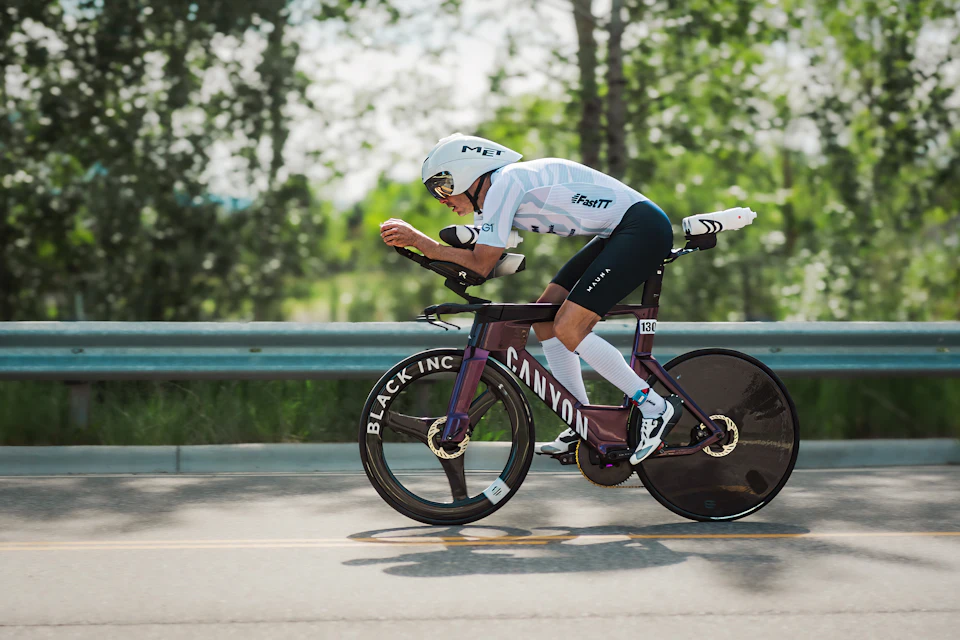
An Olympic triathlon is a 1500 m swim, a 40 km bike ride and a 10 km run. British Triathlon calls it the standard distance, and in the UK you need to be 17 (by 31 December of the race year) to enter. It is the usual next step after a sprint and is exactly double the open-water sprint distance.
This guide explains the Olympic triathlon distance in kilometres and miles, the wetsuit and drafting rules that apply to age-groupers in UK races, what changes when you step up from sprint, and two UK races that offer the distance in 2027.
Olympic triathlon distance
The figures come from Appendix A of the British Triathlon Competition Rules 2026 (April 2026 version). Miles are rounded.
| Leg | Distance | In miles | Compared with an open-water sprint |
|---|---|---|---|
| Swim | 1500 m | 0.9 mi | Double (sprint 750 m) |
| Bike | 40 km | 24.9 mi | Double (sprint 20 km) |
| Run | 10 km | 6.2 mi | Double (sprint 5 km) |
The minimum age is 17 under British Triathlon rules. World Triathlon, whose rules apply at races abroad held under them, sets it at 18. If you plan to race an Olympic distance in another country at 17, check which rules that race follows.
Standard or Olympic: one distance, two names
British Triathlon uses the word standard. Most athletes and many organisers say Olympic or Olympic distance. You will see both on UK entry pages for the same 1.5 km, 40 km and 10 km format. Royal Windsor Triathlon uses both words on its pages, and the London T100 lists an Olympic race. They describe the same distance. For the full range of formats, from super sprint to long, see our guide to triathlon distances.
What changes when you step up from sprint
Doubling every leg does more than double the effort. A few things are worth planning for.
- The swim. 1500 m in open water is the biggest change for most people coming from a sprint triathlon. You will spend much longer in the water, so cold, sighting (looking up to check your line to the next buoy) and swimming in a group all matter more.
- Pacing. A sprint can be raced hard from start to finish. Over a standard distance you need to hold back on the bike so that you can still run 10 km well.
- Fuel and drink. The race is long enough that most people drink on the bike. Practise this in training and read the organiser's information about aid stations on the run.
- Transitions. T1 (swim to bike) and T2 (bike to run) still count towards your time, but they are a smaller share of a longer race. Practise them so they feel routine.
Wetsuit rules for a 1500 m swim
British Triathlon sets wetsuit rules by water temperature, swim length and age (your age on 31 December). An Olympic swim of 1500 m falls in the category for swims up to 1500 m, which has the lower upper limit.
| Swim length | Age | Wetsuit mandatory below | Wetsuit forbidden above |
|---|---|---|---|
| Up to 1500 m | 59 and under | 15.9 °C | 22 °C |
| Up to 1500 m | 60 and over | 15.9 °C | 24.6 °C |
| 1501 m and over | All ages | 15.9 °C | 24.6 °C |
Between the two limits, a wetsuit is optional. The rules recommend that novices and age-groupers up to 59 wear one up to 22 °C, and those aged 60 and over up to 24.6 °C. The London T100 participate page lists its dock swim as 18 to 24 °C with wetsuit, which shows how close to the limits a summer race can be. If you need a wetsuit, see our triathlon wetsuit guide.
When the swim is shortened
Early and late in the season, cold water can cut an Olympic swim short. Under rule 4.4 of the British Triathlon rules, there can be no open-water swim in competition below 11 °C. The maximum swim is 1000 m at 13 °C, 600 m at 12 °C and 300 m at 11 °C. The temperature is taken one hour before the start. A 1500 m swim can therefore become a 1000 m swim on a cold morning. Train for the full distance anyway, and read the race briefing on the day.
Drafting rules for age-groupers
Drafting means riding close behind another cyclist to shelter from the wind. Age-groupers are amateur athletes who race in age categories, and most people in a UK Olympic triathlon are age-groupers. Under World Triathlon rules, age-group racing at standard distance is draft-illegal, which means you must not sit in another rider's slipstream. UK race information will tell you whether a race is non-drafting.
The British Triathlon Competition Rules 2026 define the bike draft zone like this:
- The zone is 12 m long, measured from the leading edge of the front wheel of the rider ahead.
- You may enter another rider's zone, but you must be seen to be progressing through it.
- You have a maximum of 25 seconds to pass through the zone.
- Repeated attempts to pass that do not succeed can also be an offence.
- Behind a motorbike, the draft zone is 15 m.
Leave enough space when you ride behind someone, and commit to the pass when you decide to overtake. For more on penalties, helmets and transition, read our guide to triathlon rules in the UK.
UK races with an Olympic distance
These two races list the full 1500 m, 40 km and 10 km distance on their own websites. Details checked on 6 October 2026. The 2026 editions have already taken place.
| Race | Swim | Distance offered | 2026 (past) | 2027 |
|---|---|---|---|---|
| Royal Windsor Triathlon | River Thames, downstream then upstream | Standard 1500 m / 40 km / 10 km | 14 June | 13 June |
| London T100 Triathlon | Royal Victoria Dock, fresh water | Olympic 1.5 km / 40 km / 10 km | 25 to 26 July | 21 to 22 August |
Royal Windsor Triathlon
Run by RunThrough from Alexandra Gardens in Windsor, the race was first held in 1991. The swim goes downstream on the River Thames and then back upstream. The bike is on open roads, so the Highway Code applies, and the run heads into Windsor Great Park along the Long Walk. The organiser's minimum age for the Standard race is 17, the same as British Triathlon's, and 15 for the sprint. A relay is also offered.
London T100 Triathlon
The London T100 age-group races are held at ExCeL London with a freshwater swim in Royal Victoria Dock. The Olympic race sits alongside sprint, super sprint and a 2 km, 80 km and 18 km T100-distance race. The organiser had not stated a minimum age or whether roads are closed on the pages we checked, so confirm both before entering. Our London triathlon guide covers the event in more detail.
Training for an Olympic triathlon
Most people preparing for a first Olympic distance train three or four times across the three sports in a week at first, building to six or more sessions. A typical week includes two swims (one technique, one longer continuous swim), two rides (one longer and steady, one with harder efforts) and two runs (one easy, one longer). Add a brick session, a ride followed straight away by a short run, every week or two.
Keep most training easy, increase it gradually, and practise open-water swimming at a supervised venue. Our Olympic triathlon training plan sets out sample weeks. Plans are general guidance and cannot promise a result. If you have a medical condition or have been inactive, see your GP before starting hard training.
Frequently asked questions
What is the Olympic triathlon distance?
The Olympic triathlon distance is a 1500 m swim, a 40 km bike ride and a 10 km run, which is about 0.9 miles, 24.9 miles and 6.2 miles. British Triathlon calls it the standard distance. Organisers sometimes adjust a course to suit the venue, so check the race's own course page before entering.
How old do you have to be to do an Olympic distance triathlon?
Under the British Triathlon Competition Rules 2026 the minimum age for standard (Olympic) distance is 17, counted as your age on 31 December of the race year. Royal Windsor Triathlon also states 17 and over for its Standard race. World Triathlon rules, which apply to races abroad held under them, set the minimum at 18.
Can I wear a wetsuit in an Olympic triathlon?
It depends on the water temperature. A 1500 m swim falls in the British Triathlon category for swims up to 1500 m. A wetsuit is mandatory below 15.9 °C. It is forbidden above 22 °C for athletes aged 59 or younger and above 24.6 °C for athletes aged 60 or older. Between those limits it is optional. The organiser confirms on race day.
Is drafting allowed in age-group Olympic triathlons?
Usually not. World Triathlon rules make age-group standard-distance racing draft-illegal, and UK race information tells you if a race is non-drafting. Under British Triathlon rules the draft zone is 12 m from the leading edge of the front wheel ahead, and you have a maximum of 25 seconds to pass through it.
Sources
- British Triathlon Competition Rules 2026 (April 2026), Appendix A, rules 4.2 and 4.4, drafting rules, checked 6 October 2026
- World Triathlon Competition Rules 2026, Appendix A and section 5.5, checked 6 October 2026
- Royal Windsor Triathlon: about the event, checked 6 October 2026
- RunThrough: Royal Windsor Triathlon June 2027, checked 6 October 2026
- London T100 Triathlon: participate, checked 6 October 2026